Current Issue
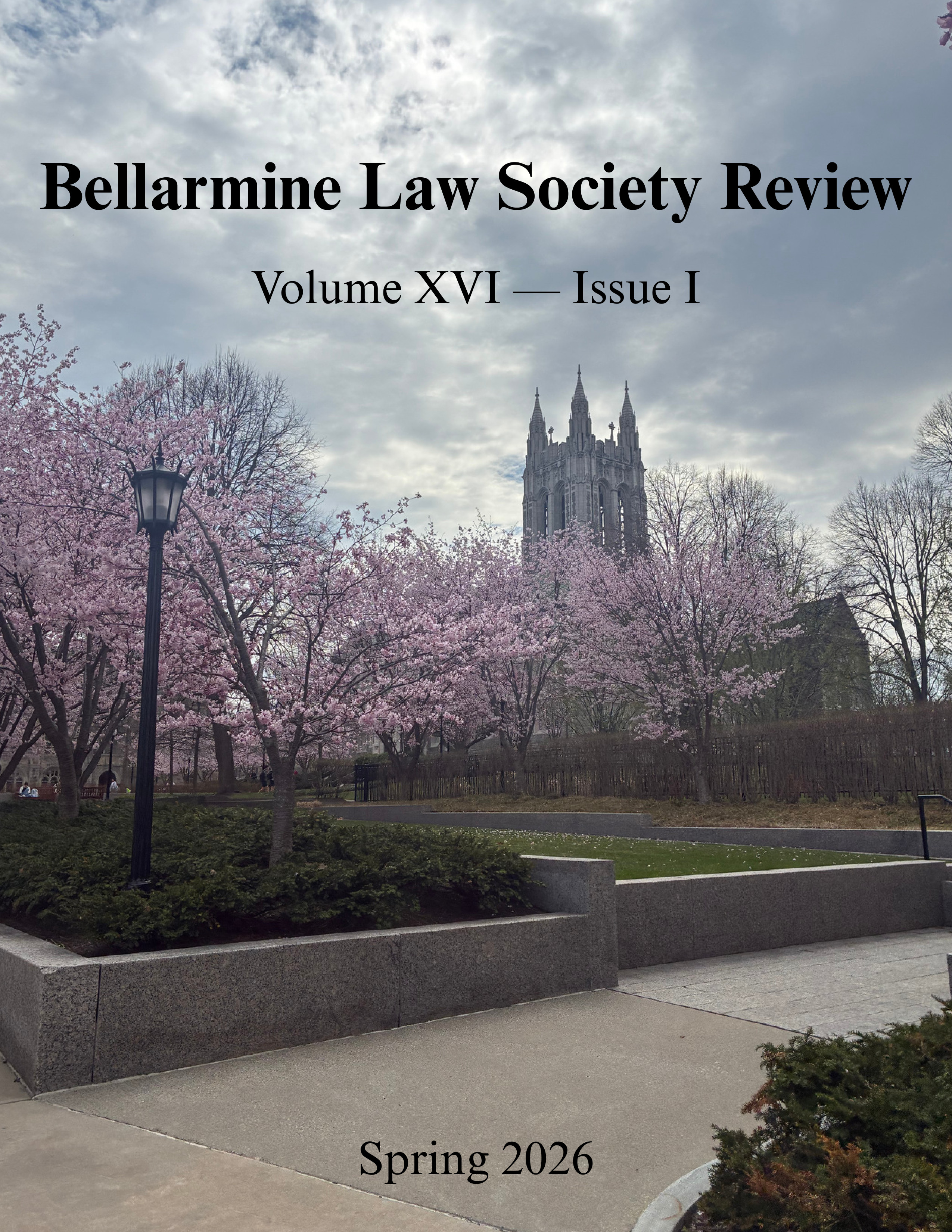
Vol. 16 No. 1 (2026): Bellarmine Law Society Review
For this spring edition, we feature four papers from outstanding authors at Boston College and beyond, each engaging with pressing legal questions. First, Zade Hirsch of Boston College examines the legal and economic performance of medical malpractice damages caps, arguing that while such caps modestly reduce certain payouts, they function primarily as a redistributive mechanism and fail to address broader drivers of healthcare costs. Next, Audrey Brower of the University of Michigan offers a joint economic and legal analysis of Cavalleri v. Hermès International (2025), contending that the alleged tying practices reflect consumer preferences for exclusivity rather than unlawful anticompetitive conduct. Third, Zoe Wen of Georgetown University explores the fallibility of eyewitness memory, integrating psychological and neuroscientific research to demonstrate how memory can be distorted and proposing evidence-based reforms to improve the reliability of testimony. Finally, Kate Kissel of Boston College reevaluates the fair use doctrine in the context of LLMs, arguing for a more balanced application of the four factors under Section 107 to better protect authors’ rights in an evolving technological landscape.
Published:
05/03/2026
Full Issue
Articles
Welcome to the Bellarmine Law Society Review.
The BLSR is Boston College’s premier source of undergraduate scholarship relating to the law. Although the BLSR is supported and managed by Boston College students, it provides the opportunity for undergraduates across the U.S. to contribute to national legal discourse.
The Boston College Bellarmine Law Society, which sponsors the BLSR, is a student organization founded over thirty years ago with the intention of providing resources and information to prepare students for law school. The society is named after St. Roberto Francesco Romolo Bellarmino (1542-1621), a Jesuit theologian and defender of the Roman Catholic Church.
Whether you are an author, researcher, librarian, or otherwise interested reader, I hope the BLSR is an informative and engaging source for further legal study.
-----
Simon Hoefling, Editor-in-Chief